

Library & FAQs
Newsletters

Frequently Asked Questions
The BSSA transmission line will be constructed in both Minnesota and South Dakota and the two states have different regulatory processes and timelines. On January 30, 2025, the South Dakota Public Utilities Commission (SD PUC) approved the Facility Permit Application for the South Dakota portion.
We filed the Minnesota Route Permit application with the Minnesota Public Utilities Commission (MN PUC) in October 2024. On April 30, 2026, the MN PUC gave verbal approval of the Route Permit, and we received the written approval on June 25, 2026. You can learn more about the filing by visiting the eDocket page. You can also learn more about how the MN PUC Permitting Process works here.
The project kicked off in early 2023, and a series of open houses were held in April and October 2023, and February and June 2024. Information gathered during these open houses were considered in preparing our permit applications to the South Dakota Public Utilities Commission (SD PUC) and the Minnesota Public Utilities Commission (MN PUC). Learn more about our past events by visiting the Events page.
After easements have been acquired, construction is expected to begin Spring 2028, with the new line tentatively scheduled to be complete by the end of 2030.
Landowners within and adjacent to the approved route will be contacted by a ROW agent directly. You’ll also receive additional communications from the project team about timing, next steps, and other coordination. Landowners can find additional information on our Landowner’s page.
The typical structure will be approximately 150-foot-high, single-pole, self-weathering steel with double- circuit capability, meaning it can support a second set of conductors. While this is the proposed design, the structure type may vary due to a variety of reasons. We'll continue to share more details as they become available.
The transmission line is being constructed to increase overall reliability of the grid not only in South Dakota and Minnesota, but across the Upper Midwest. This transmission line is not being built because of one specific energy project, but it's possible that future energy generation resources, including wind, may connect to this line in the future. If this occurs, the entities responsible would be subject to a separate MN PUC permitting process as well as the MISO Generation interconnection process.
Otter Tail Power Company and Missouri River Energy Services will undergo a consultation process with federal and state agencies to protect sensitive species within the right of way.
Right of way is a portion of land needed for the construction, operation, and maintenance of the transmission line. Typically, a width of 150 feet is needed for a 345-kV transmission line. Right of way is typically secured through negotiation and acquisition of an easement agreement.
To assess potential routes and conduct the necessary environmental, engineering, and geologic studies/surveys, right of way agents will work with landowners and residents to acquire a temporary right-of-entry agreement. This agreement does not give permission for construction.
An easement is the legal document that allows Otter Tail Power Company and Missouri River Energy Services to construct, operate, and maintain transmission structures and lines on your property.
A 150-foot-wide easement will be necessary to construct, operate, and maintain the proposed 345-kV transmission line.
EMF is an acronym for the phrase "electric and magnetic fields". For transmission lines, EMF should be considered separately - electric fields and magnetic fields, measured in kilovolt per meter (kV/m) and milliGauss (mG), respectively. Electric fields are dependent on the voltage of a transmission line, and magnetic fields are dependent on the current carried by a transmission line. The strength of the electric field is proportional to the voltage of the line and diminishes rapidly as the distance from the conductor increases. The intensity of the magnetic field is proportional to the current flow through the conductors, and magnetic field levels decrease rapidly as the distance from the centerline increases. Learn more about EMFs at EMF Electric and Magnetic Fields Associated with the Use of Electric Power (nih.gov).
The best way to stay informed is to visit our website and sign up for our newsletter. You can also email us or call (800) 598-5587 with questions, comments, or concerns. Landowners and residents along the approved route will receive information throughout project development.
Related Projects
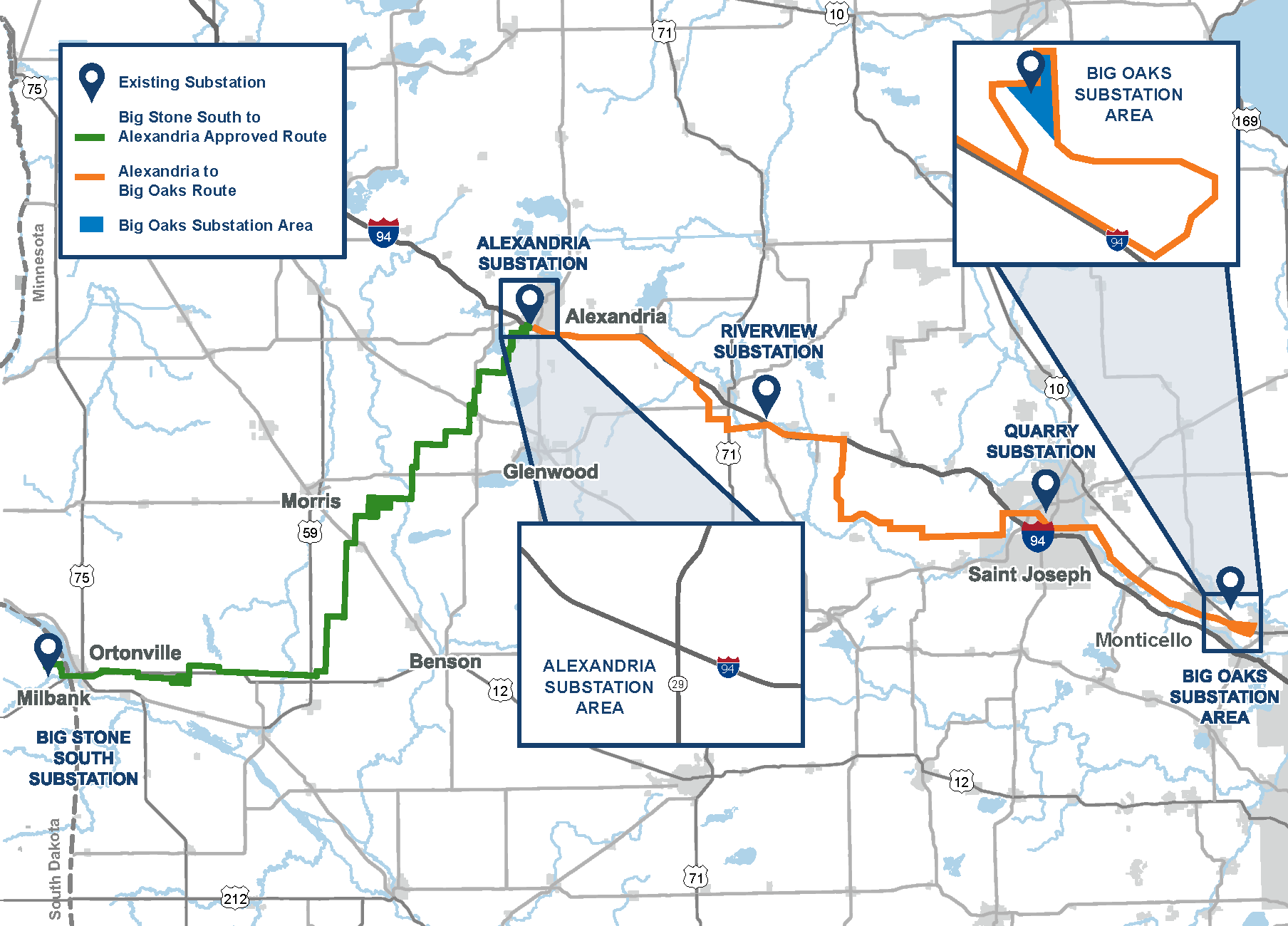
This Big Stone South to Alexandria (BSSA) project is the western segment of a larger project called Big Stone South to Alexandria to Big Oaks.
Alexandria-Big Oaks
The eastern segment of the project, identified as the Alexandria to Big Oaks (ABO) project, is being developed by Otter Tail Power Company, Missouri River Energy Services, Great River Energy, Minnesota Power, and Xcel Energy and will add a new transmission circuit to the existing 345-kV transmission structures that run mainly along Interstate 94. The ABO segment will connect to the existing substation near Alexandria, Minnesota and the proposed Big Oaks substation near Becker, Minnesota. Along with the Certificate of Need, the Minnesota Public Utilities Commission also granted the Route Permit for this segment on October 3, 2024.
- Certificate of Need: 22-538
 Approved October 2024
 - Route Permit: 23-159 Approved October 2024
Learn more about the Alexandria to Big Oaks Transmission project.
 View maps